Workplace Emergency Preparedness: A Practical Guide for Leaders

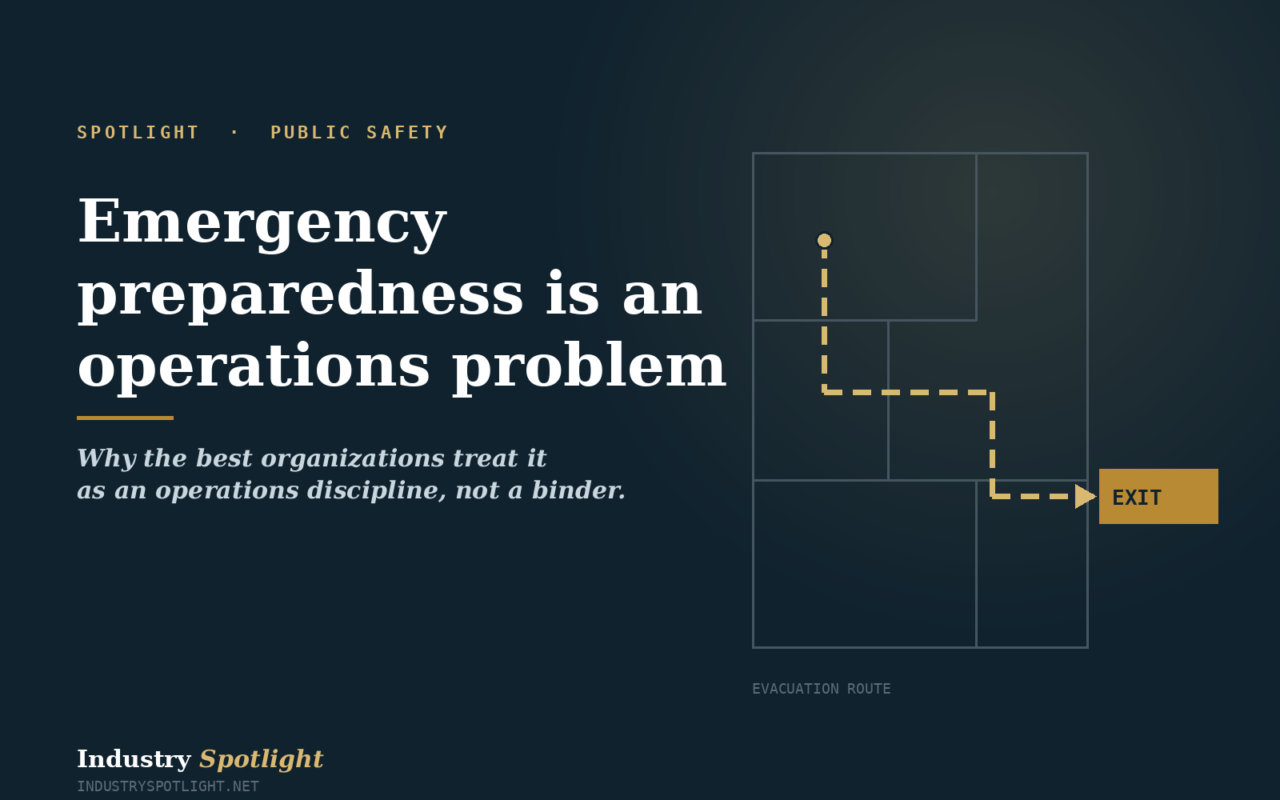
Every organization believes it will rise to the occasion on its worst day. Most will not. The difference rarely comes down to courage or budget. It comes down to whether preparedness was treated as real operational work, rehearsed and owned, or as a binder that satisfied an auditor and then went on a shelf.
The organizations that come through a fire, a flood, a violent incident, or a long outage with their people and their business intact tend to share a habit. They treat emergency preparedness the way they treat any other core function: they assign it to someone, they measure it, they practice it, and they improve it. This piece lays out what that discipline looks like in practice, and where a leader can start.
What “prepared” actually means
Preparedness is not a document. It is the capacity of a group of ordinary people to take the right actions in the first few minutes of a crisis, before professional responders arrive. Federal guidance makes the same point in plain terms: the actions taken in the initial minutes of an emergency are critical, and a prompt, well-drilled response can save lives and limit damage, according to Ready.gov, the preparedness resource run by FEMA.
That framing matters because it moves the goal. The objective is not a compliant plan. The objective is a building full of people who know what to do when the alarm is real. A plan is one input to that outcome, not the outcome itself.
Emergency preparedness is an operations problem
Most organizations file preparedness under compliance. That is the first mistake. Compliance asks a single question: does the plan exist and meet the minimum? Operations asks a better one: will this work under stress, with the people we actually have, on a day nobody is at their best?
Framed as operations, preparedness inherits the tools that already make an organization run. It gets an owner. It gets a schedule. It gets metrics, such as how long a full evacuation takes and whether everyone was accounted for. It gets reviewed after every drill and every near miss, the same way a good team runs a retrospective after a project. Treated this way, preparedness stops being a cost center and becomes a capability.
What resilient organizations do differently
They start with an honest risk assessment
A plan built for the wrong emergency is worse than useless, because it creates false confidence. Resilient organizations begin by naming the hazards they can actually expect, from fire and severe weather to power loss, chemical exposure, and acts of violence, then plan for the most likely first. FEMA’s Ready Business program organizes its toolkits around exactly this kind of hazard-by-hazard thinking.
They put the plan in writing and make it findable
In the United States, this is not optional for most employers. Under OSHA’s emergency action plan standard, a written plan is required once an organization has more than 10 employees, and it must include six minimum elements: how to report an emergency, how to evacuate and by which routes, what to do about critical operations, how to account for everyone afterward, how rescue and medical duties are handled, and who to contact with questions. The full requirement is set out in OSHA standard 1910.38. The stronger organizations treat those six elements as a floor, not a ceiling, and they keep the plan somewhere people can actually reach it.
They name who is in charge
Confusion kills minutes, and minutes matter. Effective plans assign clear roles before anything happens: who calls emergency services, who directs the evacuation, who checks the rooms, who does the head count. This is the logic behind the Incident Command System, the standardized command structure that FEMA promotes through the National Incident Management System for coordinating a response. The principle scales down to a small office just as well as it scales up to a stadium: someone is in charge, and everyone knows who.
They drill it, then review it
A plan that has never been exercised is a theory. Training, testing, and exercises are the components that turn a document into a reflex, and they are where most programs fall short. The organizations that get this right run realistic drills, time them, note what broke, and fix it before the next one. The drill is not the deliverable. The corrected plan and the faster, calmer response are.
They build first-response capability into the room
The person most likely to save a life in the first minutes is not a paramedic. It is whoever is standing next to the injured person. That insight drives the Stop the Bleed program, launched in 2015 and run by the American College of Surgeons, which notes that bleeding is the number one cause of preventable death after injury. More than five million people have now trained in three basic actions: apply pressure, pack the wound, and use a tourniquet. Placing bleeding-control kits and defibrillators where people can find them, and training staff to use them, extends the same operational thinking to the human body.
They plan to keep operating
Life safety comes first, but the crisis does not end when the building empties. Resilient organizations pair their emergency plan with a continuity plan that answers the next questions: how the business communicates with employees, customers, and officials, and how it restores critical operations and data. Ready.gov’s business resources treat communications and continuity as core parts of the same program, not as afterthoughts.
Why the binder approach fails
The compliance binder fails for a simple reason: it optimizes for the inspection, not the incident. It tends to be generic, so it does not match the building or the team. It is rarely practiced, so no one has muscle memory for it. And it is treated as finished the day it is signed, so it never absorbs the lessons of the last drill or the last close call. On the day it is needed, it produces exactly what a disorganized response looks like, which is confusion, delay, and avoidable harm.
None of this requires a large budget. It requires ownership and repetition. A modest plan that is genuinely rehearsed will outperform an elaborate one that no one has read.
Where to start this quarter
Leaders who want to move from paperwork to real capability can begin with a short, concrete list:
- Name an owner for preparedness, and give the role real time, not just a title.
- Run one honest risk assessment and rank the hazards you can actually expect.
- Confirm your written plan covers the six required elements and matches your actual floor plan.
- Schedule a real drill this quarter, time it, and hold a short review afterward.
- Put bleeding-control kits and a defibrillator where people can reach them, and train staff to use them.
- Write down how you will communicate and keep operating if the building is unusable for a week.
You can go deeper on the public-institution side of this work in our Public Safety & Government coverage, and on the execution side in Operations & Project Delivery.
Frequently asked questions
What is an emergency action plan?
An emergency action plan is a written document that spells out what employees and managers should do during a workplace emergency, including reporting, evacuation routes, accounting for people, and medical duties. For most U.S. employers with more than 10 employees, it is required and must contain six minimum elements under OSHA 1910.38.
How often should we run drills?
There is no single legal number for every workplace, but the practical answer is often enough that the response becomes automatic and every new employee has practiced it. Many organizations drill at least annually, and higher-risk sites do so more frequently. The value comes from timing each drill and correcting what went wrong before the next one.
Does a small business really need a written plan?
Under OSHA, an employer with 10 or fewer employees may communicate the plan orally rather than in writing. Even then, writing it down is worth the hour it takes, because it removes ambiguity during training and during an actual emergency.
What is Stop the Bleed?
Stop the Bleed is a national public awareness and training program run by the American College of Surgeons that teaches bystanders to control life-threatening bleeding using pressure, wound packing, and tourniquets. You can find courses and kits at stopthebleed.org.
The through line across all of it is unglamorous and reliable: preparedness is a practiced capability, not a document. The leaders who internalize that, and who give the work an owner and a schedule, are the ones whose organizations are still standing after the worst day.